canada.gif

gb.gif

de.gif

us.gif
Neil Young's new release ""World Record" w/ Crazy Horse is now available for pre-order. Order here
(Please shop locally & independently. But if you can't, we appreciate your supporting Thrasher's Wheat by clicking this link or YOUR COUNTRY's FLAG. Thank you!!!)
ADVERTISEMENT
<-Older Posts Blog Home

Monday, December 12, 2022

Comment of the Moment: Neil Young - Alone Together With The Loner

Neil Young
Illustration by Mike Faille, from Kiim Kong photo
(Click photo to enlarge)


The Loner.

Neil Young has many, many nicknames like "Shakey", "Mr. Soul", "Godfather of Grunge", etc.  And then there is "The Loner".  

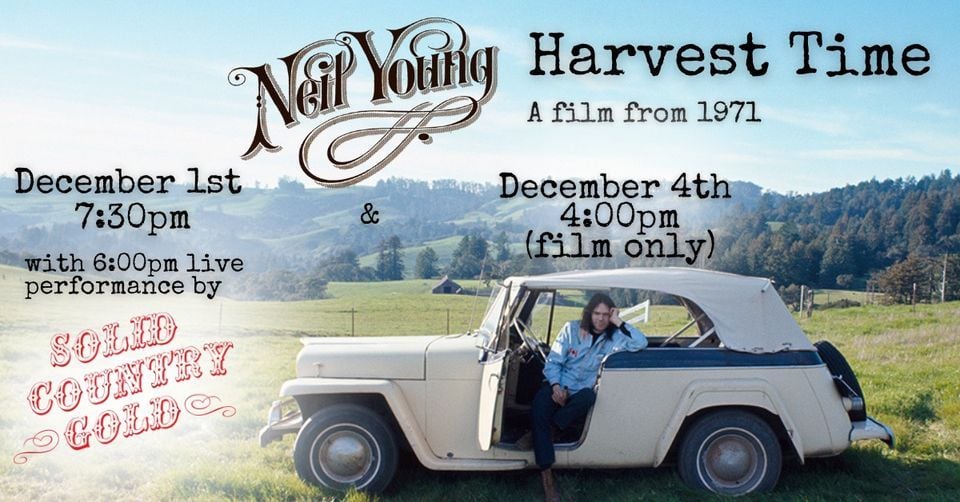
In the film "Harvest Time"  (see ANALYSIS: What "Harvest Time" Reveals About Neil Young), a side of  Neil Young is seen -- yet unseen -- that many fans identify with in a comfortingly relatable manner.  As in, literally, see the lonely boy out on the weekend trying to make it pay.

Neil Young's Harvest Time Film


In listening to Neil Young's extensive lyrics, the theme of "loneliness" quite often hovers about many of his songs.  A theme which is very prevalent, pervasive and persistent over the decades.  Thus, the TW Comment of the Moment on ANALYSIS: What "Harvest Time" Reveals About Neil Young by Dionys:

The Loner Alone, a Lonesome List 

  • Bad Fog Of Loneliness
  • Campaigner (“I am a lonely visitor”)
  • Everybody’s Alone
  • Four Strong Winds (“Four strong winds that blow lonely…”)
  • Give Me Strength (“The lonely man I make myself to be”)
  • Hard Luck Stories (“Now she’s gone and you’re alone…”)
  • Harvest (…and was some black face in a lonely place…)
  • Hello, Lonely Woman
  • Hold Back the Tears (Single life really has its fine points…”)
  • Like An Inca (There’s a bridge I have to cross alone…”)
  • Lotta Love (“Cause my heart needs relating not solitude”)
  • Mellow My Mind (”lonesome whistle on a railroad track”)
  • Misfits (“On the Needles Highway there is a lone red rider…”)
  • Oh, Lonesome Me
  • Out on the Weekend (“See the lonely boy out on the weekend”)
  • Roll Another Number (“though I long to see that lonesome hippie smile”)
  • Sample and Hold (“But not the lonely one…”)
  • Sunny Inside (From now on I ain’t scared of lonely nights...”)
  • Tell Me Why (”I am lonely but you can free me)
  • The Loner
  • The Losing End (When You’re On) (“Before I wandered off alone”)
  • There Goes My Babe
  • The Wayward Wind (“In a lonely shack by the railroad track…”)
  • Too Lonely
  • When You Dance I Can Really Love (While the lonely mingle with circumstance”)
  • When Your Lonely Heart Breaks
  • Will to Love (“But I won’t turn back with this lonely tide)
  • Wonderin’ (I am wondering if I’ll be alone”)

Sure I missed out on a few songlines

UPDATE:

+ Down By The River ("It's so hard for me staying here all alone..") (Thanks Abner!)

+ Old Man  (live alone in a paradise) and (but I'm all alone at last) (Thanks Nobody knows!)

+ Last Trip to Tulsa (Sure it's not a case of being lonely we have here...)

+Music Arcade - ("Have you ever felt all alone") (Thanks Sancho!)

Thanks Dionys, Abner, Nobody Knows, Sancho & Still Young and everyone on the thread.

Step aside, open wide.

And the ultimate irony here is that watching Neil in "Harvest Time" write the song “Out on the Weekend” -- apparently spontaneously -- while happily laughing away and surrounded by friends and lovers is most incongruously surreal.

You folks out there make us feel never alone as long we have friends digging the music.

More on ANALYSIS: What "Harvest Time" Reveals About Neil Young.

 
Neil Young Gets Back “Out on the Weekend”


Labels: , , , , , , , ,


<-Older Posts Blog Home

Saturday, December 10, 2022

ANALYSIS: What Harvest Time Reveals About Neil Young | Rock and Roll Globe

 
Neil Young's Harvest Time Film
 

Here is a highly recommended analysis of the just released documentary presenting a fuller look at the landmark album  "What Harvest Time Reveals About Neil Young | Rock and Roll Globe" by Pat Daly:

Neil Young acolytes, notably loyal and reliably obsessive, took the Decade blurb and constructed a parable that is now part of the gospel according to Neil freaks. The three records that followed Harvest – Time Fades Away, Tonight’s The Night, and On the Beach – are now enshrined as “The Ditch Trilogy.”  

The one slight problem here is that Harvest is every bit as ditchy as the records that followed, maybe ditchier. 

It starts with what could be the bleakest, most depressive utterance of Neil Young’s career, which is saying something. “Out On the Weekend” surveys the inner life of its lonely protagonist, who is getting ready to abandon his present circumstances, and just “pack it in.” He “can’t relate to joy.” It is foreign to him. He’d explain it, but his depression has rendered him incapable of speech. “He can’t begin to say.”

Surely the middle of the road beckons as the record goes on, and the ride is uphill from here, right? Well, kind of. The two songs that give Harvest its mainstream reputation – “Heart of Gold” and “Old Man” – are testaments to want, yearning, and more loneliness. 

The former is about the search for love, by all accounts futile to date, and time is running out on our 24-year-old artiste. Inability to articulate persists. “It’s these expressions I never give, that keep me searching for a heart of gold – but I’m getting old.” 

The picture painted in “Old Man” is not much rosier. Love has not been kind to our lonely boy, and he sorely needs someone to love him the whole day through. His lyric does not exude optimism. “Love lost, such a cost. Give me things that won’t get lost.”

These three numbers – can I propose we refer to them henceforth as The Loneliness Trilogy? – constitute less than a third of the album. The rest of the album surely must contain the soothing “Sweet Baby James”-ish folk pop that explain its mellow reputation and enduring popularity. 

A few quick notes on this highly recommended analysis. First, we rustie grains don't really like the label "obsessive" and prefer "passionate" instead. Second, here at TW, we have been a major proponent of the “The Ditch Trilogy” theory.  In fact, this  “The Ditch Trilogy” theory has been expanded to a  quadrilogy, or possibly even a quintology.

Neil Young's "Ditch Quadrilogy":
"Time Fades Away", "Tonight’s the Night", "On the Beach" & "ZUMA"


Last point, on this analysis is the stream of consciousness composition of “Out on the Weekend” which rivals anything from the much ballyhooed Peter Jackson documentary "The Beatles: Get Back" scenes. The ever so elusive "The Muse" is seen in full force display on her majestic, creative, channeling journey. So, get back to that John & Paul, literally and figuratively.


Neil Young Gets Back “Out on the Weekend”


Labels: , , , , , , , ,


<-Older Posts Blog Home

Friday, December 09, 2022

Comment of The Moment: "Alabama" & Neil Young's "Harvest Time" Film

joel-bernstein-neil-young-1972-2-sm.jpg
 "Alabama"
Neil Young - Sept 10, 1971
NYA Vol #1 Boxset Photo by Joel Bernstein
 

In the film Neil Young's 'Harvest Time', there are extensive scenes from The Barn of the recording of the song "Alabama", as well as, Neil discussing the song as "not a political statement" but a song "about himself".

In other words, Neil Young is downplaying the whole "Southern Man" and "Alabama"  

This statement by Neil Young is downplaying the whole politics of "Southern Man" and "Alabama" in 1971 is obviously well before it became a legendary myth feud with Lynyrd Skynyrd's iconic "Sweet Home Alabama"

lynyrd-skynyrd-vanzant-crop.jpg neil-young-lynyrd-skynyrd-t-shirt.jpg
Ronnie Van Zant with Neil Young "Tonight's The Night" T-shirt
Oakland Coliseum, July 2, 1977 - Photo by Michael Zagaris
Neil Young with Lynyrd Skynyrd/Jack Daniels Whiskey T-Shirt
Verona, Italy 7.9.1982 - Photo by Paolo Brillo on Flickr
(via Thrasher's Wheat @ http://neilyoungnews.thrasherswheat.org/2022/12/comment-of-moment-alabama-neil-youngs.html )


In fact, the quotes in the film make it sound like Neil could of picked the State of Mississippi randomly, but probably found just that Alabama worked much better lyrically.  Neil Young (paraphrased from memory):

“I just wanted to use the name of a state in the American South. Because that’s where the guy is coming from in that song. It’s not necessarily about Alabama.” And then, “I don’t know what I’m talking about.”
Which brings us yet again, to another TW  Comment of The Moment on the post  REVIEW: Neil Young's Harvest 50th Anniversary Edition (CD/DVD) | All About Jazz by Tomatron:

Given the insight added by the Harvest Time quote regarding Alabama, the song can be seen in, if not a brand new light, a more complex one, where it is elevated above its status of Southern Man II. It seems like the self-referential lines begin to incorporate more nods to Southern and country culture as the verses add up.

At first, the subject is primarily Neil himself, dropping minor allusions to keep that country tone going (“the devil fools with…” “swing low,”) as he expresses his personal feelings at the end of March ‘71 [NYA manuscript caption]. “You got the spare change, you got to feel strange” is his ambivalent mood about being a “rich hippie.” “And now the moment is all that it meant” sounds like a critique of a hippieism itself. In the original manuscript, Neil put the word “moment” in quotes, tellingly.

Where Southern Man was a straightforward social commentary and political statement, Alabama is a metacognitive meditation, a critique/questioning of self. 

Here the singer sings to himself, playfully naming himself “Alabama.” He recognizes that he is affecting an American style, all the while an outsider. This perspective will be developed in a later line, so let’s look at that chorus first. Rusties will recognize the references to self right out the gate. “…weight on your shoulders that’s breaking your back,” was written between Neil’s major back injury and the resultant surgery. We know he was in physical pain during this time and would hardly stand up with an electric guitar until months later. 

“Your Cadillac has got a wheel in the ditch and a wheel on the track.” Know anyone with a fondness for big old cars and ditches? [note: The first Caddy I could find in Special Deluxe was the limo he bought in ‘74 when he and Zeke were on the road with the CSNY tour.]

The next verse names Alabama as the person/subject and, separately, as the place itself (“broken glass windows down in Alabama”) The irony of banjos playing through these broken windows but that also “take you down home” speaks to the personal conflict already established and connects it to the character’s namesake state. The chorus returns, reinforcing the pain and strife of the singer/his subject. The final verse brings back Neil’s discomfort with fame living in the States. “Oh Alabama, can I see you and shake your hand?” is followed by the wry “make friends down in Alabama.” These lines bring to mind Neil’s comment in Harvest Time regarding his new famous life, where people’s eyes don’t look right when they talk to him. [Again sorry for the lack of direct quotes, I’m paraphrasing from memory of the screening last weekend.]

“I’m from a new land, I come to you and see all this ruin, what are you doing?” Another enigmatic line, but following the lyrics above, it seems he is stepping out of the Alabama identity and into the world of Southern Man, having established his own voice as full of contradiction and self-doubt. This seems to add the weight of credibility based in humility to the critical observations first laid out with “see the old folks tied in white ropes.” In fact, that particular line can be read not just as “them Southern folk are KKK,” but that they themselves are tied up, bound by the shameful side of their own heritage, unable to change. The ropes themselves are white, after all.

After asking “what are you doing?” Alabama closes with another question: “You got the rest of the union to help you along/ What’s going wrong?” A mere Southern Man retread would have left this line a reaching throwaway. It doesn’t quite make sense posed directly to the state of Alabama. But given a double meaning whose main purpose is an inward questioning, the line lands hard. We can easily see “the rest of the union” as CSN, Crazy Horse, or even the Stray Gators, from all of whom Neil has begun to isolate himself. He knows they support him, so why is he struggling? It’s worth noting that Neil had expected to be finished with Harvest by April [an offhand remark heard in the movie]. Alabama was written on March 30th, 1971 and no more recording was done until September. 

When Alabama was penned, it wasn’t quite Harvest Time yet.

Many thanks for the CotM Tomatron.  Man, this is right in our strike zone here @ TW.

As everyone knows, this whole subject of the Southern Man/Northern Man is what propelled this site from obscurity to relative prominence and then back to semi-obscurity. 

We had always suspected that Neil distanced himself from this whole fraught subject just because of the challenge of discussing and defending in the climate extremes we face. So, frankly, it is very good to understand that this apparent backtracking -- so to speak -- occurred in the early 70's and isn't a more modern revisionist thinking/justification. In his autobiography "Waging Heavy Peace", Neil Young writes that "Alabama" was "condescending" and "not entirely thought out". 

But, we ask, are the "politics" of today really any dicier than the 60's?


"Does your conscience bother you?
Tell the truth."

Labels: , , , , , ,


<-Older Posts Blog Home

Sunday, October 09, 2022

ESSAY: "NEIL YOUNG, WELCOME SOUTH BROTHER" by Jeff Cochran

neil-MICHAEL-MULLER-CORBIS.jpg
"NEIL YOUNG, WELCOME SOUTH BROTHER"

Here is a guest essay  by Jeff Cochran chronicling the strange, intriguing, quintessential, quixotic, and quirky career of Neil Young.

The first in a series tentatively titled: "Neil Young in This Land of Conditions"? , this essay is -- ostensibly -- about "Southern Man."  
 
Previously, we have published Jeff's writing on 50 Years Ago: “Four Dead In Ohio”, which documented the various intersections of Neil Young and President Richard M. Nixon.
 
enjoy!

ESSAY: "NEIL YOUNG, WELCOME SOUTH BROTHER"

by Jeff Cochran

Anyone who has followed Neil Young’s career knows him to be spontaneous, unpredictable and quick to change direction. To some degree, that has hampered him artistically as well as commercially. To a larger degree, it has made his career fascinating.


 Last Time Around by Buffalo Springfield 
Released July 30th, 1968 
(see Buffalo Springfield's "Last Time Around" by Harvey Kubernik)


Neil Young, a native of Winnipeg, first captured interest among rock fans in 1966 as a lead guitarist, singer and songwriter with Buffalo Springfield. It wasn’t until the second of Buffalo Springfield’s three albums, however, that Young gained equal footing with band mates Stephen Stills and Richie Furay. Then as the band recorded its third and final album, Last Time Around, Young was on his way out the door. A promising solo career awaited.

His first album, Neil Young, had a couple of rockers but the mood overall was more introspective and romantic than the follow-up, Everybody Knows This is Nowhere. While the first album evoked the aura of “Out of My Mind,” “Broken Arrow,” and “Expecting to Fly,” Young’s softer selections from the Buffalo Springfield catalog, the second album, featuring Young’s new band Crazy Horse, called to mind his “Mr. Soul,” one of Buffalo Springfield’s all-out rockers.

In the meantime, just after the release of Everybody Knows This is Nowhere, Young hooked up once again with Stills, who had formed a new band, one of the first of the so-called “super groups,” with David Crosby and Graham Nash. Crosby, Stills and Nash had just released a wildly successful first album featuring the hits, “Suite Judy Blue Eyes” and “Marrakech Express.” It was 1969, the year of Woodstock and men walking on the moon. Young joined Crosby, Stills and Nash on stage at the Woodstock Festival, leading to great expectations for the album due for release the next year.


The album, Déjà Vu, is considered top-drawer by many, but some selections are overwrought or cute. Young did contribute the sweet and mournful “Helpless” as well as “Country Girl” and  “Everybody I Love You,” co-written with Stills. There were also concert appearances by CSNY across the country, resulting in the live two-record set, Four Way Street. The title was appropriate. The group could blend beautifully and determinedly at times, but there were four separate agendas and none more separate and captivating than Young’s.

"After the Gold Rush" by Neil Young
(see Discovering After the Gold Rush: The Story Behind The Album Cover)


Young’s agenda was on full display some 8 months before the release of Four Way Street. His third album, After the Gold Rush, released on August 31, 1970, was immediately deemed a classic. The initial enthusiasm for the album has not only held but increased over the last 52 years. Rock critic Robert Christgau called the album “a rarity, pleasant and hard at the same time.”

Members of Crazy Horse played on After the Gold Rush as did other musicians. Nils Lofgren, better known for his guitar work, played a haunting piano, giving the album a deep and dark dramatic flair. Lofgren’s contributions were pivotal. Instinctively, he perceived the aura Young sought, and enabled listeners to absorb it, as many of the album’s songs carried listeners on a journey to life’s darker places, destinations where lost love, dashed hopes, environmental peril, and violence encroach.


Filming "Journey Through The Past"
Columbus, GA - October 1972

photo by Joel Bernstein
via Neil Young Archives


One violent outpost is visited in “Southern Man.” This song, along with “When You Dance I Can Really Love,” is one of the album’s two rockers. However, “When You Dance…” rocks in a way that connects with the desire expressed in the song. The musicians play with joyful determination similar to that of “Cinnamon Girl,” the opening track on Everybody Knows This Is Nowhere. But “Southern Man” rocks with a sense of foreboding and the terror found in the Deep South in the ’60s. It is not happy rock and roll.

burning-cross.jpg
"Now your crosses are burning fast
southern man"


The scenarios in the song recall the malice of fire-hosings in Birmingham. Young, harking back to the days of slavery, sings of the tall white mansions and little shacks, imploring the Southern Man to compensate Blacks for what they’ve endured, before and after slavery. He scathes the hypocrisy of the Southern Man, who believes in what the “good book says,” but doesn’t recognize the humanity in certain creatures of God. In the song’s second verse, the Southern Man rails at a white woman who has a “black man comin’ round.” And he swears he will “cut him down.” Young had previously explored the menacing demons that can overwhelm people, but never so emphatically. The anger possessing Young is akin to one who witnesses such cruelties daily and has grown tired of his own silence in the face of continuing injustice. Even though the prolific Young has recorded dozens of great songs since, “Southern Man” still deserves paramount attention for its dramatic tone and steadfast resolve.

The story of the song goes beyond the song itself, however. There’s the response to the song.  That is, the response of people who heard the song or heard about it. Many Southerners have long taken umbrage at outsiders pointing out the sins of their region, particularly sins regarding race. They believe the news media keeps the matter of racial discrimination front and center. Even those whose families would’ve never owned a slave in the 19th century or those who’d sit contentedly next to a Black person on the bus in more contemporary times prefer the subject closed. They know it’s a shameful piece of history that hits close to home. The white man with the kind heart and a special empathy for his Black neighbors also recalls his own family members whose spirits were not so generous. There were family members who discriminated and even those who profited by keeping blacks down. The family members were wrong but they are beloved family members, and since family supposedly trumps all, it hurts when the subject is raised since they, by now, believe it properly settled. 

Generous to a fault they may seem, they don’t take into account that their own discomfort with the issue hardly equates to what victims of the racial divide suffered. They might also overlook their own present wealth and comfort, perhaps derived from prejudice against the weak empowered by governmental complicity in the several generations before. They didn’t hold the whips or the ropes or have a voice in the laws allowing repression but many among us have gained materially from the old injustices. If they’d acknowledge as much, it would be a positive step.

Granted, those Southerners didn’t want someone from up North, north of the United States in particular, to chastise their neighbors and loved ones in such a brutally explicit way, even in song. After all, they had read of the bad treatment Dr. Martin Luther King received in Chicago. Therefore, it was reasoned, a Northerner could hardly be the one to judge. To them it seemed Neil Young, a long-haired rock and roller from Canada, was disparaging all white Southerners.


It likely got under a white Southerner’s skin even more when his teenagers were listening to “Southern Man,” and while a bit hesitant to say so, the kids knew Neil Young was right and they were glad he wrote the song. And they did not know it just yet, but Young would again take on the issue of race in the South. Not only that, but there would be rejoinders from emerging Southern rockers with their own take on the matter. The teenagers could acknowledge that rock music was tackling serious subjects. Then too, they would say, Neil Young plays an awesome guitar on “Southern Man.”


More To The Picture Than Meets The Eye . . . During the Civil War, Atlanta, Georgia was considered the workshop and warehouse of the Confederacy. As Sherman left it in flames, Atlanta’s fall led to President Lincoln’s reelection and a Union victory.

A century later, Atlanta came to be known as the “Cradle of the Civil Rights Movement.” Martin Luther King, Jr. was born in Atlanta in 1929 and was buried in his hometown 39 years later, a martyr to the cause of Civil Rights, one who paid the ultimate price for the dignity of all men and women. Not every Atlantan bought into the spirit of the civil rights movement, but overall, the city has served as a shining example of how Blacks and whites in government and business can work together, a perfect example being Atlanta’s successful efforts to host the 1996 Olympics.

deja-vu-film-poster-sm.jpg
 "CSNY DEJA VU" Film Poster - 2008
Documentary of 2006 Freedom of Speech tour


So Atlanta, a blue city in a red state, seemed natural for a CSNY concert appearance during their 2006 Freedom of Speech tour. Atlanta had welcomed the world in ’96 and had generally* been a successful stop for Neil Young, having played the city numerous times since the ’70s, appearing at the Omni, the Fox Theatre, Philips Arena and the amphitheatres.

Touring behind Young’s album, Living With War, the reunited CSNY were again striking blows against the empire. The set lists throughout the tour included their anti-war songs from the late ’60s and early ’70s such as “Wooden Ships,” “Military Madness.” and “What Are Their Names,” augmenting Young’s new songs which denounced the United States’ invasion of Iraq. Other well-known sociopolitical songs featured in the concerts were “Teach Your Children,” “Find The Cost Of Freedom” and “For What It’s Worth,” each long embraced by those to the left of America’s political center.

In the early to mid ’80s, it was a more politically conservative Neil Young speaking out on the issues of his adopted country, voicing disapproval over Jimmy Carter and endorsing Ronald Reagan’s arms policies. Young’s comments, however, made their way into the music press when a string of lackluster albums brought his career to a low ebb. Only his hard-core fans, quite use to his mercurial inclinations, took note of the jingoism then influencing his political thoughts. In the late ’80s, when Young revived his career, he also seemed to shift away from the political right, as indicated by the material on his album, Freedom. Absorbing the American mood after Ronald Reagan’s two terms as president, Young noted a country riding high in the material world but unable to secure equanimity of spirit. His observations were key in making Freedom one of his most resonant and vital albums.
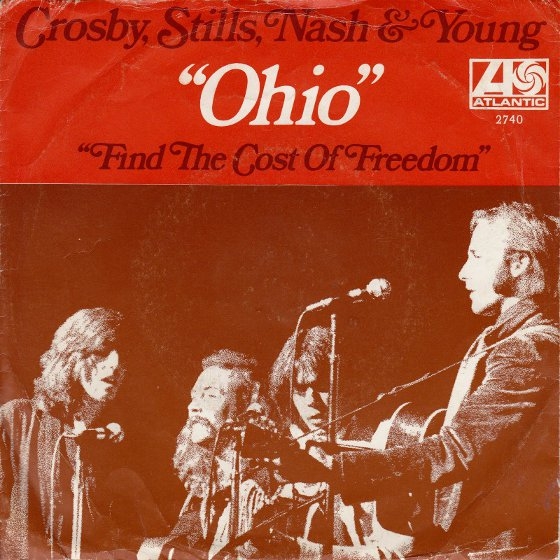

"Ohio" 45 Atlantic Records Single (w/ "Find The Cost of Freedom")
by Crosby, Stills, Nash & Young - May 1970


As with the Kent State killings which inspired him to write “Ohio,” the most fiery protest song of the rock era, and the discriminatory treatment of blacks in the South which led to his writing “Southern Man” and “Alabama,” it is when Young is most incensed about war, bigotry and misuse of government power that he throws himself head-first into writing and promoting his political songs. The war in Iraq, and especially the way President Bush led his nation into battle, with unfounded claims of Iraq’s “weapons of mass destruction,” and the Mission Accomplished appearance when at least 3,900 more American soldiers were yet to die in the war, were among the things incensing Young in the new century’s first decade. Those things also upset millions of Americans, many who set aside a good chunk of the week’s grocery budget to see Young, with Crosby, Stills and Nash, musically inveigh against the war that was eating away at America. Young assertively promoted the Freedom of Speech tour and Living With War with a special online site that went beyond hawking the musical endeavors. Mainly, he took strong issue over what appeared a betrayal by the people, who, as David Crosby put it, are “the men who really run this land.”  

Yes, there was a lot out there regarding the songs featured in the Freedom of Speech tour as well as the assumed political leanings of CSNY. So how was it that hundreds of people who paid their way into Atlanta’s Philips Arena to see the group on August 10, 2006 had such little idea of what was driving the group, particularly Young? And why, if they chose to go to a concert highlighting freedom of speech, were they so hostile when that freedom was exercised? They may have paid more than $100.00 a ticket to see the concert, but they held back on the southern hospitality, seeming to demand a higher cost for freedom of speech and appearing ridiculous all the while.

In his film about the Freedom of Speech tour, CSNY/Déjà Vu, director Neil Young (using the alias Bernard Shakey) does a superlative job in not only covering the tour, but also examining the anguish suffered by those who fought in the Iraq War as well as the anger felt by millions of Americans helping to foot the bill for a war they opposed. President George W. Bush, who led the US into a war of choice, is mocked in the film for his decisions and a bumptious attitude exhibited that’s inappropriate, given the troubles afflicting the nation.


Crosby Stills Nash & Young - 7/6/2006 - Camden, NJ
2006 Freedom of Speech Tour
photo by Buzz Person (via CSNY.net)


The anger felt toward Bush was palpable across America, but in the minds of hundreds who attended the Atlanta Freedom of Speech concert, the president was due a free pass. Never mind all the mistakes he made in office, they thought a rock singer such as Neil Young had some nerve accusing the president of lying. When CSNY broke into “Let’s Impeach the President” from Living With War near the end of the showmany at Philips Arena stood to cheer the sentiment. Also standing, but not in approval, were those who booed the song and Young, giving him, the band and the cameras the finger. Hundreds walked out, as was their right, and, before the cameras, utilized their “freedom of speech,” with some asinine and obscene suggestions directed at Young. There were others, who kept it clean, but indicated a lack of understanding about the meaning of free speech, especially when it’s unpopular.


Ronnie & Neil:
"We hope you remember that
around anyhow. 
Now, more than ever."


Southern Man Don’t Need Him Around . . . One gentleman, noting the vast amount of Southerners killed in the Iraq War, said,”You don’t come to the South singing this kind of stuff and springing it on somebody.” Another opinion, albeit less thoughtful, came from a man on the concourse, who determined that, “If you’ve never been shot at or never had to shoot at anyone, then you have no right to blame the government, because they’re …  they’re smarter people up there. You may not realize it, but they’re smarter than you.” The poor guy probably has no idea, but his words make him sound as one who, in the words of the song, “Living With War,” would “bow to the laws of the thought police.”

 The more circumspect of the people who walked out of Philips Arena that night would have done well to consider Young’s message as one critical of Bush, yet loyal to the nation, and especially those in uniform. President Bush wasn’t forthcoming in justifying America’s invasion of Iraq. He wasn’t loyal to the American people, taking advantage of them while they yearned for leadership after the 9/11 attacks. It seems a hazy memory now, but in the wake of 9/11, millions of Americans set aside partisan politics to support and hope the best for George W. Bush. The people were afraid of what would happen when the other shoe dropped, many of them unaware of how the Bush Administration would gain more power while misleading them.

All of the charges Neil Young made against George W. Bush in “Let’s Impeach The President,” which so angered many Atlanta concert-goers that evening, wouldn’t have gone very far in Washington’s corridors of power. Sadly, many of those in the legislative bodies, whose views came to more closely match Young’s than the Bush Administration’s, had granted approval for America’s invasion of Iraq. They too, if their consciences remain intact, will live with war every day.


lynyrd-skynyrd-street-survivors-original-cover.jpg
Street Survivors by Lynyrd Skynyrd
(original album cover)
Ronnie Van Zant wearing a Neil Young "Tonight's the Night" album cover t-shirt


When You Write Your Songs . . . Years ago a prominent reviewer, genuinely fond of Neil Young, wrote that Young’s voice and guitar could often be grating to some listeners. Well, yes. Sometimes Young’s singing and playing are rough, but often there’s beauty in his aggressive style. He certainly can shock some of his more casual listeners. The man who sang sweetly of looking in both Hollywood and Redwood for a heart of gold one year later sang grimly but energetically about “14 junkies too weak to work.” Neil Young covers a lot of ground; he surprises, shocks and challenges his listeners, sometimes to the point, like with many in Atlanta in 2006, they walk out in anger. Yet less than three years later, a line formed around a prestigious Atlanta venue to see Neil Young in concert. The great ones not only entertain, they intrigue.

*The 2003 Atlanta appearance at Chastain Amphitheatre in which songs from the “Greendale” were featured was not well-received.  Atlanta amphitheater attendees are not concept album types.

lynyrd-skynyrd-vanzant-crop.jpg neil-young-lynyrd-skynyrd-t-shirt.jpg
Ronnie Van Zant with Neil Young "Tonight's The Night" T-shirt
Oakland Coliseum, July 2, 1977 - Photo by Michael Zagaris
Neil Young with Lynyrd Skynyrd/Jack Daniels Whiskey T-Shirt
Verona, Italy 7.9.1982 - Photo by Paolo Brillo on Flickr
(see Ronnie and Neil: Laying to Rest the "Feud Myth" Once and For All)

Thanks for sharing with us here @ TW, Jeff! Much appreciated and very interesting food for thought here on one of our very favorite subjects: the duality of the southern thing.

Looking forward to more words here on Neil.

Until next time, see previously published writing  by Jeff Cochran on 50 Years Ago: “Four Dead In Ohio”, which documented the various intersections of Neil Young and President Richard M. Nixon.


Labels: ,


<-Older Posts Blog Home

Sunday, June 07, 2020

Neil Young Tweets: "It’s ON THE STREET" - The Saga of "The Southern Man Story" Rages On


"It’s ON THE STREET"
via NeilYoungNYA | Twitter

Neil Young has tweeted out the message "It’s ON THE STREET".


The tweet by Neil Young is in solidarity with the Black Lives Matter movement and the global movement against the brutality of the police state.

16th St., NW - Washington, D.C.

Last week, Neil Young streamed a 2019 solo acoustic version of ‘SOUTHERN MAN’ on Neil Young Archives as a timely reminder of a long running observation back from 1970. "It’s not just ‘Southern Man’ now. It’s everywhere across the USA. It’s time for real change, new laws, new rules for policing," Neil writes on the NYA post.


Also, Neil Young has written a Viewpoint: Hope on Neil Young Archives saying that: "My black brothers and sisters have suffered long enough."


Viewpoint: Hope by Neil Young
via Neil Young Archives

Over the weekend, we posted on The Story of Neil Young's "Southern Man". The post covers the song's background and context along with a transcript of the "Southern Man Rap" from bootlegs of a Neil Young concert on May 16, 1974 at The Bottom Line, New York City.

For us here at TW, the whole entire issue of "Civil War 2.0" has been a continuous and lifelong issue and the core of our blogging for 25 years now as long time readers can attest.


"Ronnie and Neil"
We do hope that you will remember that a Southern Man needs Neil Young around anyhow. Now, more than ever. OK?!

We've often been asked why exactly do we devote so much attention to this whole "Ronnie and Neil" business?

On the one hand, it seems blatantly obvious when you look at the musical arc and the huge cultural impact of songs like "Alabama", "Southern Man", Lynyrd Skynyrd's "Sweet Home Alabama", and Drive-By Truckers' "Ronnie and Neil" and their interconnectedness.

skynyrd-sweet-home-alabama.jpg
Lynyrd Skynyrd's "Sweet Home Alabama"
MCA Records 45RPM Single

We have written at length about the interconnectedness "Four Dead in Alabama" and the "Four Dead in Ohio".

four-dead-girls-alabama.jpg
The Four Dead in Alabama + The Four Dead in Ohio

The "feud myth" between Lynyrd Skynyrd and Neil Young was brilliantly captured by the Drive-By Truckers 2002 album "Southern Rock Opera" song "Ronnie and Neil", as we've again discussed at length over the years.

drive-by-truckers-Southern-Rock-Opera.jpg
Southern Rock Opera
Drive-by Truckers

Also, see Northern Man, Southern Man and The Un-Civil Wars of Donald Trump & Neil Young and Southern Man and Northern Man: Ronnie and Neil, The Un-Civil Wars & Rebels with Causes.

lynyrd-skynyrd-street-survivors-original-cover.jpg
Street Survivors (original album cover)
Ronnie Van Zant wearing a Neil Young "Tonight's the Night" album cover t-shirt

So for us, as The #BigShift rolls along, our life's work is coming into crystal clear focus front and center. (Not withstanding the punches that came fast and hard lying on our back in the schoolyard") While gratifying that folks may just pay attention this time and learn something, our hopes have been raised before only to be dashed by the "ignorance is bliss" crowd.


Filming "Journey Through The Past"
Columbus, GA - October 1972

photo by Joel Bernstein
via Neil Young Archives

Hey, Hey, My, My, this is the story of Donnie, Ronnie and Neil.


"Don't forget what your good book said "
U.S. President Donald Trump @ St Johns Church
Washington, DC - June 2, 2020


Northern Man and Southern Man?
Donald Trump & Neil Young - 2014


And, so why exactly might a southern black woman cover a white Canadian man's ode to racism in the Confederate south again, now anyhow?


"Does your conscience bother you?
Tell the truth."

Lynyrd Skynyrd's Ronnie Van Zant


Daughters of the Confederacy Statue Removed
Old Town, Alexandria, VA - June 2, 2020
"Those who cannot learn from history are doomed to repeat it.
Those who do not remember their past are condemned to repeat their mistakes."

~~ George Santayana
or...
“Every record has been destroyed or falsified, every book rewritten, every picture has been repainted, every statue and street building has been renamed, every date has been altered. And the process is continuing day by day and minute by minute. History has stopped. Nothing exists except an endless present in which the Party is always right.”
~~ George Orwell, 1984
or...
"Those who control the present, control the past and those who control the past control the future."
~~ George Orwell, 1984


Labels: , , , , , , , ,


<-Older Posts Blog Home

Thursday, December 05, 2019

VIDEO: Merry Clayton's Southern Soul Cover of Neil Young's "Southern Man"

Merry Clayton


Over Thanksgiving holiday, we re-watched the film "20 Feet From Stardom" and were reminded of Merry Clayton.


And you say who is Merry Clayton???

Clayton sang back up vocals on Neil Young's "Old Laughing Lady". Above, watch Merry Clayton covering Neil Young's "Southern Man" around 1972/3 (@~14:30).

Also, Clayton was the intensely female backup vocal on the Rolling Stones original version of "Gimme Shelter". And, she was one of the original Rayettes (Ray Charles female backup singers).

Merry Clayton's was brilliant on The Who's "Tommy" soundtrack on "The Acid Queen" with symphony orchestra backing.

And, she sang backup on Lynyrd Skynyrd's "Sweet Home Alabama", that song that some think"put Ol' Neil down".

Southern soul for a southern man from a southern woman.

1969 - Merry Clayton recorded The Old Laughing Lady and I Loved Her So Long with Neil Young

1971 - Merry Clayton recorded Southern Man as a solo artist

1974 - Merry Clayton recorded Sweet Home Alabama with Lynyrd Skynyrd

And, so why exactly might a southern black woman cover a white Canadian man's ode to racism in the Confederate south again, now anyhow

From the film "20 Feet From Stardom", Merry Clayton discusses her backup vocal on The Rolling Stones' "Gimme Shelter". Note Mick Jagger's reaction when Clayton's voice breaks on lyrics "Rape, Murder".


Also, see Northern Man, Southern Man and The Un-Civil Wars of Donald Trump & Neil Young and Southern Man and Northern Man: Ronnie and Neil, The Un-Civil Wars & Rebels with Causes.


We hope you remember that a Southern Man needs Neil Young around anyhow. Now, more than ever.

Labels: , ,


<-Older Posts Blog Home

Monday, June 17, 2019

Neil Young's New Album 'Tuscaloosa': "Duality of the Southern Thing" or Does A Southern Alabama Man Need Neil Young Around, Anyhow?


"Make friends down in Alabama.
I'm from a new land
I come to you and see all this ruin
What are you doing Alabama?"

The timing of Neil Young's release of the album Tuscaloosa recorded on Feb. 5, 1973 with the band Stray Gators at Memorial Coliseum, University of Alabama in Tuscaloosa appears to be somewhat auspicious.

The state of Alabama has been in the news of late -- but not necessarily for advancement of progressive causes -- bringing yet another round of ridicule and scorn.

From 1973 to 2019, such is the duality of the Southern thing -- as we often note here on this blog. So, is "Sweet Home Alabama" really so sweet? Depending on your perspective of the "duality of the Southern thing", aside from "The Three Great Alabama Icons", well, yes, maybe A Southern Man Does Need Neil Young Around, Anyhow.

Which brings it all back to Neil Young's release of the album Tuscaloosa and the iconic song "Alabama" and its damning lyrics.


Neil Young's new album "Tuscaloosa" - Released Date June 7, 2019

From Neil Young to release live album from 1973 Tuscaloosa concert by Mark Hughes Cobb:
One of those who saw the ’73 Neil Young show was Steve Wombacher, then writing for a Tuscaloosa publication called The Boll Weevil, later The Current, now defunct. In following years, Wombacher would become a concert organizer himself, heading the University of Alabama’s University Program Council, booking Little Feat, Clapton, Waters, Ronstadt, Presley, the Commodores and others, along with non-musical acts who could fill Memorial, such as Steve Martin.
When Young and band launched into “Southern Man,” fans braced for reactionary boos and taunts. Instead, the 10,000-ish crowd cheered Young’s anti-racist, anti-violence sentiments.

“In the ’70s, Tuscaloosa was actually a pretty hip little town,” Wombacher said, “for Alabama.”

From the perspective of a fan, Wombacher’s surprised Young decided to release this particular set.

“He showed up lethargic,” Wombacher said. “Best as I remember, he had injured his back, or somehow hurt his back, he was on major painkillers, and could barely move his left hand. Even when he sat at the piano, it was clearly tough on him.

“I’m shocked they’re actually releasing it. Maybe it sounds a lot better on the recording.”

Writing his review, Wombacher remembers noting the opening act scored far better, playing tighter, more energetic: Linda Ronstadt and the Stone Poneys. Though they’d had an early hit with Michael Nesmith’s “Different Drum,” Ronstadt was just emerging as the hit-making solo artist she’d be four years later, when Wombacher booked her as a Memorial headliner. Among her touring band members were Glenn Frey and Don Henley, who decided, while backing her, to form the band that would become the Eagles.

“They were just smoking; they were on fire,” Wombacher said. “I thought, ‘You’re in trouble, Neil.’ ”

Tuscaloosan Bruce Hopper’s main impression of the night was that it was a welcoming crowd.

“By that time (Young) had pretty much established where he was politically,” said Hopper, a musician and former owner of the late and lamented bar the Chukker. No seats behind the stage were opened, so capacity would have been in the vicinity of 10,000. Hopper couldn’t remember if it was full, but it was close, he said, including probably every left-leaning person in the region.

“Everybody knew that he was the political one, but I don’t remember any hecklers or anything like that. Everybody there seemed to feel the words in ‘Southern Man’ were true and appropriate; they were cheering real loud.” Hopper was disappointed to discover that night’s “Southern Man” performance wouldn’t be included on “Tuscaloosa.”

On the Chukker’s Facebook group, fans recalled Young’s messed-up back, and the pro-“Southern Man” feel. David A. Smith, from Dothan, was working with the University Program Council that night, but with his tasks completed pre-show, he was free to roam.

“I recall a very good concert, with great musical choices,” he said. “When Young launched into his little digs before ‘Southern Man,’ we just cheered him on. We were all in fine spirits, although he possibly thought we were all crazy.”

Young kept on rocking in the free world, albeit from a chair, said Bit Barrett.

“I remember him playing a lot of electric while sitting in a rocking chair and wondering if he could stand up. He did, but he was skyrocket high. Still it was a great show,” Barrett wrote.

Though he’d rather have seen Young teamed with Crosby, Stills and Nash, or earlier band Buffalo Springfield, still it was a “phenomenal” show for fan Daryl Brown.

“I seem to only remember his sitting on stage singing and playing his old Martin guitar,” Brown wrote. “Wow, 40-odd years later and Neil and I are still here. Who’d have ever figured?”
More memories of Neil Young's concert recording album Tuscaloosa on Feb. 5, 1973 with the band Stray Gators at Memorial Coliseum, University of Alabama in Tuscaloosa on Neil Young to release live album from 1973 Tuscaloosa concert by Mark Hughes Cobb.

lynyrd-skynyrd-vanzant-tonights-joint.jpg
Lynyrd Skynyrd's Ronnie Van Zant wearing a Neil Young "Tonight's The Night" T-shirt
Oakland Coliseum Stadium, July 2, 1977

Photographer: Michael Zagaris on Wolfgang's Vault

Also, see Southern Man and Northern Man: Ronnie and Neil, The Un-Civil Wars & Rebels with Causes.

Labels: , , , ,


<-Older Posts Blog Home

Willie for a Nobel!
#Willie4Nobel

Willie Nelson for Nobel Peace Prize
for Farm Aid and his work on
alternative fuels, and world peace initiatives.

farm-aid-logo.gif
Farm Aid

Go Farmers Markets!


"In the >field< of opportunity
It's plowin' time again."

SUPPORTER
logo
Silverline Communications

(Home of the FarmAidians)
Tecumseh, Ontario, Canada
(519) 737-7979


This blog supports free speech!


Demand justice for Aaron:
Support "Aaron's Law" and inquiry into his prosecution

(... he didn't kill himself either...) #AaronDidntKillHimself

Induct Neil Young & Crazy Horse
Into the Rock and Roll Hall of Fame


Please Help Support Independent Media &
Non-Corporate Advertising
This Blog's For You!


The Hypocrisy of the Mainstream Media

It's Been Called The
"Missing Link" in the Ditch Trilogy

time-fades-away-banner2a

Sign the Release "Time Fades Away" Petition
Join The 10,000+ Who Have Already Signed


broken-arrow-mag-new-logo.gif

Neil Young Appreciation Society


sugar-mtn-logo.jpg
Sugar Mountain

Neil Young Setlists
rust-radio-new
Rust Radio


bumpersticker-neil-concert.jpg


i-l-ove-neil-young-sm.jpg
Bands Covering Neil Young songs


bumper-sticker-live-music-better-sm.jpg
LIVE MUSIC IS BETTER


ny-times-logo.jpg
Official Neil Young News Site

bridgeschool_logo
The Bridge School


The Bridge School Concerts
25th Anniversary Edition

**100% of Proceeds to Benefit Bridge School***

linda-eastman-neil-young-sugar-mtn-sm.jpg
The Essential Neil Young

neil-young-sleeveless.jpg
Fans Favorite Neil Albums

neil-young-heart-of-gold-film-still
Top 50 MP3
Neil Young Song Downloads


Top 10 Best Selling Neil Albums Today
amazon-neil-store.GIF
Support Thrasher's Wheat
via Purchases from:
United States - Amazon.com us.gif
Canada - Amazon.ca canada.gif
United Kingdom - Amazon.uk gb.gif
Germany - Amazon.de de.gif


Neil Young Songbook Project

In the fields of wheat

"Children of Destiny" will NOT be harvested
However, the chaff will be burned by unquenchable fire

Neil Young + Promise of the Real

Europe 2016 Tour Dates


2015 Rebel Content Tour


Neil Young & Crazy Horse
Alchemy Concert Tour Reviews

Fall 2012 N. America Tour
Spring 2013 Australia/New Zealand Tour
Summer 2013 Europe Tour

Europe Summer 2014 Concert Tour
Neil Young & Crazy Horse

Thrasher's Wheat Radio Supporters Go To Europe

jttp-film-poster-sm.jpg
Neil Young Films

musicares-neil-young-2010.jpg
2010 MusiCares Honors Neil Young

Features Elvis Costello, Crosby Stills & Nash, Sheryl Crow, Josh Groban, Ben Harper, Elton John, Norah Jones, Lady Antebellum, Dave Matthews, James Taylor, Keith Urban, and others.
Proceeds from sales go to MusiCares,
which helps musicians in need of
financial and medical assistance.

live-rust-promo-poster.jpg


"There's more to the picture
Than meets the eye"

#BigShift

trans-promo


Neil Young FAQ:
Everything Left to Know About the Iconic and Mercurial Rocker
"an indispensable reference"

paul-neil-bridge2004-sat-sfc-kkomenich-sm.jpg
Paul McCartney and Neil Young

woodstock-poster.jpg


"You can make a difference
If you really a try"

lennon_peace_liberty
John Lennon and Neil Young


"hailed by fans as a wonderful read"

Crosby, Stills, Nash & Young:
csny-1974-poster.jpg
The Supergroup of the 20th Century


Director Jonathan Demme's Exquisite film "Heart of Gold"

eddie & neil
Eddie Vedder and Neil Young

buffalo-springfield-poster.jpg
Revisiting The Significance of
The Buffalo Springfield


"The revolution will not be televised"
... it will be blogged, streamed,
tweeted, shared and liked
The Embarrassment of Mainstream Media

Turn Off Your TV & Have A Life


"Everything Is Bullshit" +
"Turn Off The News"
Turn Off the News (Build a Garden)


Neil Young 2016 Year in Review:
The Year of The Wheat

Kurt Cobain
Kurt Cobain and Neil Young

Neil Young's Feedback:
An Acquired Taste?

Young Neil: The Sugar Mountain Years
by Rustie Sharry "Keepin' Jive Alive in T.O." Wilson

"the definitive source of Neil Young's formative childhood years in Canada"

neil & joni
Joni Mitchell & Neil Young

europe 1987.jpg


dylan-young-crop
Bob and Neil

weld
So Who Really Was "The Godfather of Grunge"?


Four Dead in Ohio
kent state
So What Really Happened at Kent State?


The Four Dead in Ohio


May The FOUR Be With You #MayThe4thBeWithYou

concert-pass-europe-2003-solo.jpg


dissent is not treason
Dissent is the highest form of patriotism

Rockin' In The Free World


Sing Truth to Power!
When Neil Young Speaks Truth To Power,
The World Listens

emmylou-harris-neil-young-0305-crop
Emmylou Harris and Neil Young

wilco-062305-wide-background.jpg
Wilco and Neil Young

bluenotes-pass-young88crewlam-sm.jpg

bruce-springsteen-neil-young-bridge-oct-1986.jpg
Bruce Springsteen and Neil Young

europe87concertpass


elton-john-neil-young-crop-sm.jpg
Elton John and Neil Young

ronnie-vanzant-neil.jpg
Lynyrd Skynyrd and Neil Young

+

The Meaning of "Sweet Home Alabama" Lyrics


Neil Young Nation -
"The definitive Neil Young fan book"

powderfinger
"Powderfinger"
What does the song mean?

Random Neil Young Link of the Moment
neil-sad.jpg

Bonnie Raitt and Neil Young

Wisconsin-solidarity.jpg
I'm Proud to Be A Union Man

UNITED WE STAND/DIVIDED WE FALL


When Neil Young is Playing,
You Shut the Fuck Up


Class War:
They Started It and We'll Finish It...
peacefully

A battle raged on the open page...
No Fear, No Surrender. Courage
WE WON'T BACK DOWN. NEVER STAND DOWN.

"What if Al Qaeda blew up the levees?"
Full Disclousre Now


"I've Got The Revolution Blues"

Willie Nelson & Neil Young
Willie Nelson for Nobel Peace Prize


John Mellencamp:
Why Willie Deserves a Nobel

willie_picnic_poster_070503


BOYCOTT HATE

Love and Only Love

"Thinking about what a friend had said,
I was hoping it was a lie"


We're All On
A Journey Through the Past

Neil Young's Moon Songs
Tell Us The F'n TRUTH
(we can handle it... try us)

Freedom:
freedom-video
Does Anything Else Really Matter?

"Nobody's free until everybody's free."
~~ Fannie Lou Hamer

Here Comes "The Big Shift"
#BigShift

Maybe everything you think you know is wrong? NOTHING IS AS IT SEEMS
"It's all illusion anyway."

Propaganda = Mind Control
NOTHING IS AS IT SEEMS
Guess what?
"Symbols Rule the World, not Words or Laws."
... and symbolism will be their downfall...

Brighter Planet's 350 Challenge
Be The Rain, Be The Change

csny2k-plate.jpg
the truth will set you free
This Machine Kills Fascists


"Children of Destiny" - THE Part of THE Solution

(Frame from Official Music Video)

war is not the answer
yet we are
Still Living With War

"greed is NOT good"
Hey Big Brother!
Stop Spying On Us!
Civic Duty Is Not Terrorism

The Achilles Heel
#NullifyNSA
Orwell (and Grandpa) Was Right
“Emancipate yourself from mental slavery.”
~~ Bob Marley

The Essence of "The Doubters"


Yes, There's Definitely A Hole in The Sky


Even Though The Music Died 50+ Years Ago
,
Open Up the "Tired Eyes" & Wake up!
"consciousness is near"
What's So Funny About
Peace, Love, & Understanding & Music?

churchsign

Show Me A Sign

"Who is John Galt?"
To ask the question is to know the answer

"Whosoever shall give up his liberty for a temporary security
deserves neither liberty nor safety."

~~ Benjamin Franklin

Words

(Between the lines of age)


And in the end, the love you take
Is equal to the love you make

~~ John & Paul

the zen of neil
the power of rust
the karma of the wheat

~Om-Shanti.

Namaste